Monday, January 28, 2008

Winter Training

My major goal for this year was to complete Muskoka Half Ironman, but I missed the registration. I liked the date of the race. It was nicely aligning with all other plans. I will choose probably one of those:

My running goal is to match McMillan calculated time for marathon: 3 hours 30 minutes. My plan is to do it in Mississauga Marathon on May 11, 2008.

My summer goal is to finish Olympic Triathlon within first 1/2 of competition in all 3 disciplines.

My family race is Mud Run, a 10K run in a mud, where I will run as a part of a team with my wife and my son.

My training

I experimented last month and was able to wake up for workouts before work. Here is visual of my ideal training schedule:
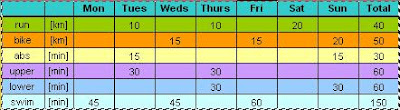
I will be practically working out twice a day with exception of Monday - which is my rest day , and Saturday - which is reserved for a long run and some family activities.
This schedule is tough and I lost somehow motivation after I missed the deadline for Muskoka 70.3. I know I will drop some workouts while focusing on specific events.

My running plan during the winter is to run inside when weather isn't cooperating, with exceptions of long runs which I always do outside on Saturday on Sunday dependent on weather.

The FIRST training program (http://www.furman.edu/first/fmtp.htm) fits nicely into my schedule. I use modified version of spreadsheet posted on the net. Plan calls for three runs in a week: speedwork, tempo run and long run. My long run is slightly different - I always try to run the second half of long run at faster speed, adding at least one km at near race pace.

--

Labels:

Friday, August 03, 2007

Summer Training

I am training for my major event of this year - Niagara Falls Half
Marathon in the end of October.

There will be small disruption in my training plan. I liked very much my attempt to Triathlon in July, my results in swimming, running and biking were satisfactory, but my time in transitions was disappointing. I want to improve my transition times for sure. I would like also to race the Olympic distance triathlon next year, so I decided to participate in slightly longer Sprint Triathlon. The Guelph II event on 01 of September seems to be the right event.

It is 750m swim, 30 km bike and 7 km run. I am expecting to beat my swimming time from my first Tri and cut a lot of transition times.

I am training hard on bike, but I am not experienced enough to predict my result. The bike distance will be 10 km longer. I hope that added part will be hilly, because I feel that I am gaining over competition on hilly parts of the road.
I think my pace should be much better during the run this time. I have added some long runs to improve my endurance. Also this time the race will start earlier, so the sun will not be at it's highest point as it was during the first race.

My goal: 1: 50:00 ( swim 16, bike 55, run 34, T1 3, T2 2). The biggest
unknown is the bike result - strong wind could add 5-10 minutes.

_________________

Labels:

Tuesday, May 08, 2007

My Training Plan

I could almost say I don't have any plan, but based on my results I revised my planned goal times. This year I would like to go below 21 minutes for 5K, and below 45 minutes for 10K. My predicted time for Half Marathon is 1 hour 43 minutes - I would be very happy if I could run it in less than 1:45 - I have noticed that my aerobic base, which plays greater role as the distance increases, is not optimally developed.

I have collected bits and pieces of information from the web. I am trying to learn as much as possible to have good results in a very short time. There is an overwhelming amount of information available on the subject. Sometimes theories and specific approaches are conflicting between each other. How often should one run, for how long and how intense? There are multiple theories and multiple answers.

'No pain no gain' school is presently replaced by 'scientific' approach - base your training on HR (heart rate) or LT (lactate threshold). One have to find out the value of MHR (maximum HR) to build a training plan based on HR zones or even better one should measure the lactic acid level in a blood to determine exercises intensity.
There are multiple formulas to calculate the value of MHR, those formulas are not very accurate and can produce result as far of as 30 bits per minute simply because people are different. So the best way to measure MHR is to take it when the body is reaching this point during very heavy exercises. Even when those values are determined zone training could be done in many different ways. There are schools of Low Heart Rate training like Maffeton method, producing good aerobic results leading to improved times for some distance runners, and doing nothing or even decreasing performance for others.

It gets much more difficult to determine the values off Lactate Threshold, one basically needs a lab to do so. What it means and how to apply those values to real training? There are multiple theories and schools. I am not ready for this yet.

I heard that increasing millage is good enough for a new runner. Increased miles by itself will produce great improvements. So my plan is to add as many miles as possible and watch the result. Or it was my plan until not so far ago. I was running around 30 km a week (kmw) in January, I have been adding more kilometers, I run 50 km a week at this point. I am feeling good and probably could go to 70-80 kmw. There is one problem - It takes many hours to run so many kilometers. In addition, during the summer months I love to ride my bicycle. I could cut hours on the bicycle if I haven't been planning to try triathlon this summer.

At this point I am thinking that I will have to improve quality of my workouts. There are speedworks, intervals, tempo runs, fartleks, and many more ways to improve running performance. I did try some but in a really casual way. I will have to study those workouts and apply it to my training especially if the result of my 10K run in Mississauga (12 of May) will be weak.

Based on my 5K race time my 10K time is predicted by various sources to be around 46min 30 sec. If my time will be worse it means that I have to make a serious revision of my training.

Labels: